29 September 1939
Three weeks after war was declared, the government took a national register of the whole civilian population, and it catches Emlyn at the exact moment the old life ended. He was not a rugby player: he had retired ten months earlier. The register gives his occupation as cinema manager, which is the job the Wigan manager Harry Sunderland had failed to talk him out of, now confirmed in a government record. Beside it, a second entry has been added: Police War Reserve, with his reserve number. Before the Army, before Larkhill and the guns, he was a wartime policeman in Salford.
Two other people share the household. Kathleen, born 11 July 1911, is recorded as a staff midwife at a hospital, qualified now and working. And a Charles O. Roberts, born January 1909, a physical training instructor and art teacher, is living with them, almost certainly the Bob Roberts who married Emlyn's sister Gwenny. Four-year-old Pat is on the page too, but her line is closed and blacked out, as the records of people not proven to have died still are.
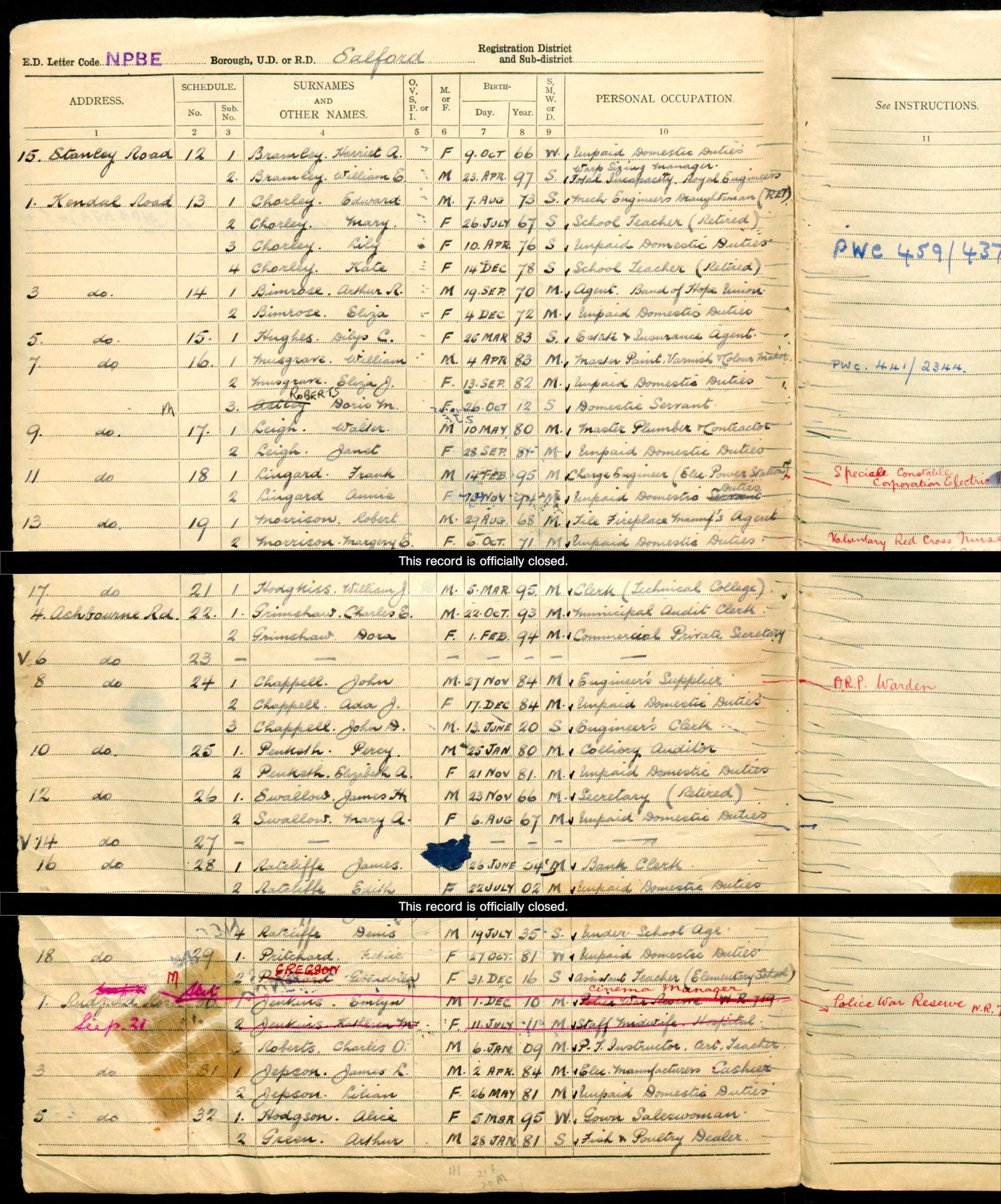
The household as recorded on 29 September 1939. Emlyn, cinema manager and Police War Reserve; Kathleen, staff midwife; and Charles O. Roberts, physical training instructor and art teacher. Click for the full page.
Source: 1939 Register, The National Archives R39, Salford registration district, in the Archive.
Then the Army. Emlyn was commissioned as an officer in the Royal Artillery, training at Larkhill, the Regiment's home on Salisbury Plain, where, among everything else, he won a medal for boxing. It was not his first time in a ring: a decade earlier, hard times in the coalfield had sent him boxing for pocket money in Dorset, of all places, not far from Larkhill itself.
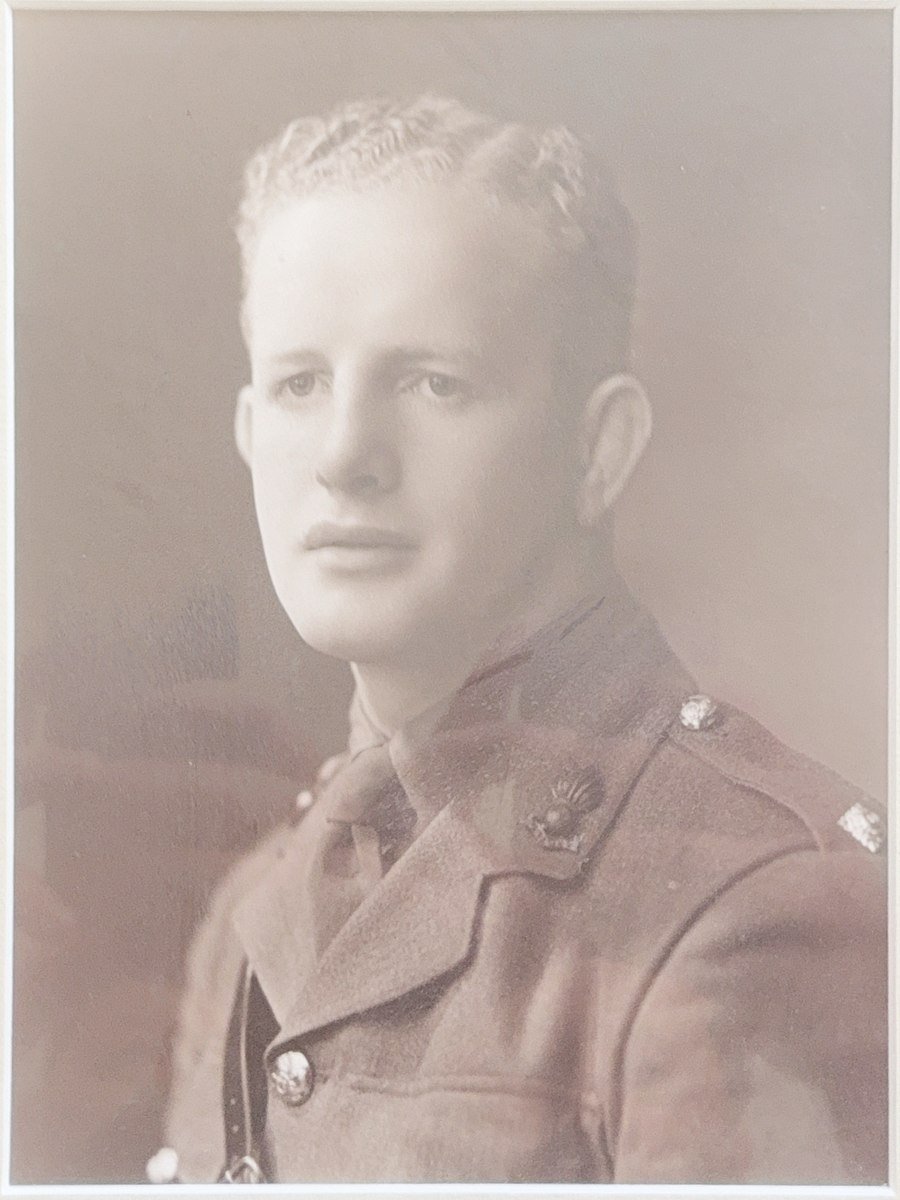
Emlyn in Royal Artillery officer's service dress. The collar badge, a flaming grenade with the motto UBIQUE, confirmed the regiment before any record did.
He then volunteered, rather than waiting to be assigned, for one of the war's least-known and most exposed roles: the Maritime Royal Artillery, gunners who went to sea aboard ordinary merchant ships to man their defensive guns under the DEMS scheme, Defensively Equipped Merchant Ships. He was stationed on the Liverpool to Belfast crossing, through the North Channel, one of the most heavily U-boat-hunted stretches of water around the British Isles throughout the war. Family memory holds that a ship he served on was sunk beneath him, perhaps more than once. He served until the end of hostilities in 1945.
His regiment's motto was Ubique, Latin for "everywhere." It turned out to be true of him in more ways than the Army ever meant it: valleys and cities, playing fields and gun decks, two countries, and eventually a third generation of schoolchildren who had no idea their teacher had once been the finest stand-off in Britain.