Emlyn had retired from playing in 1938, at twenty-seven, and the war took the next six years. When the game restarted in 1946 he came back to it from the other side of the touchline. He coached Leigh (1946 to 1947), then Warrington (1947 to 1948, where the Wires were Champions and Lancashire League winners under him), then Leigh again (1948 to 1950), and St Helens (January 1951 to January 1952), before taking charge of the representative Lancashire side and doing the odd turn as a radio commentator. He was thirty-five when he started and forty-one when he finished, and in all that time he was also training as a teacher at Risley, near Warrington.
He never entirely stopped playing, either, though he was careful about where and for whom. That part of the story is in The Long Goodbye.
Warrington, 1947-48
The best account of what he actually did in a coaching job comes from Warrington themselves. The club's commemorative book for the 1947-48 season, the year the Wires were Champions and Lancashire League winners, sets it out plainly: some time before that run of success, the Warrington directors had engaged the services of Emlyn Jenkins, the ex-Salford and Wigan off-half, as coach, and together with Chris Brockbank, the secretary-manager, the two of them had charge of the side, planning new forms of attack and defence while attention was paid to strict fitness. By then, the book says, the team spirit that had been growing steadily had reached a new height: just one happy family.
The season it describes included beating Wigan 17 points to nil, a result so unlikely that Wigan people who had not been at the match wagered the newspapers and the wireless had the score wrong, and spectators at the A team game at Central Park doubted the half-time figures on the scoreboard. There was a first trip to France, to Perpignan and Carcassonne, and a Cup run against Workington that pitched him against Gus Risman, his old Salford half-back partner's captain and his own teammate on the 1936 tour, now on the other side.
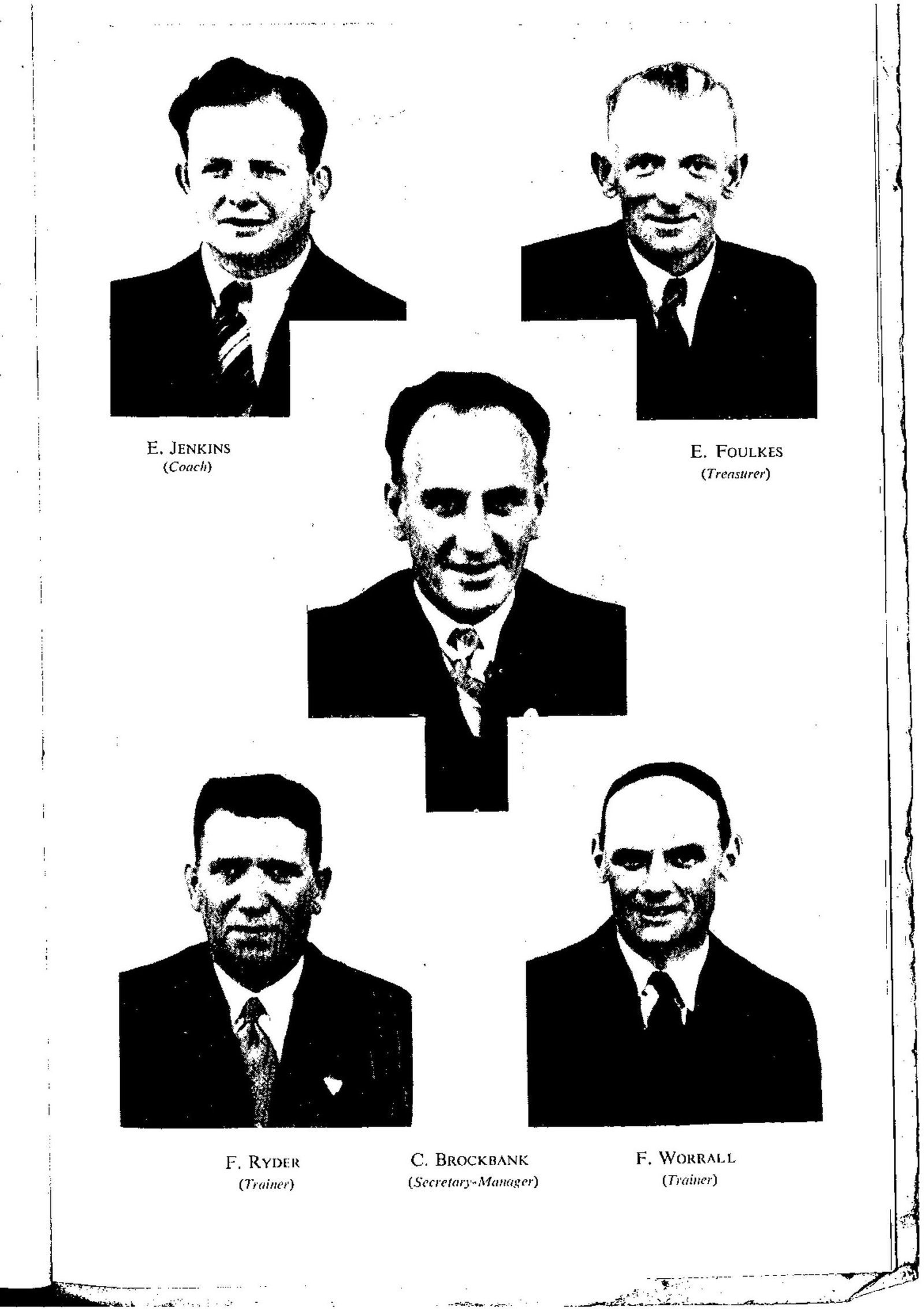
"E. Jenkins (Coach)", from the page of club officials in Warrington's commemorative book for 1947-48. Reproduced by kind permission of the Warrington Wolves Heritage volunteers.
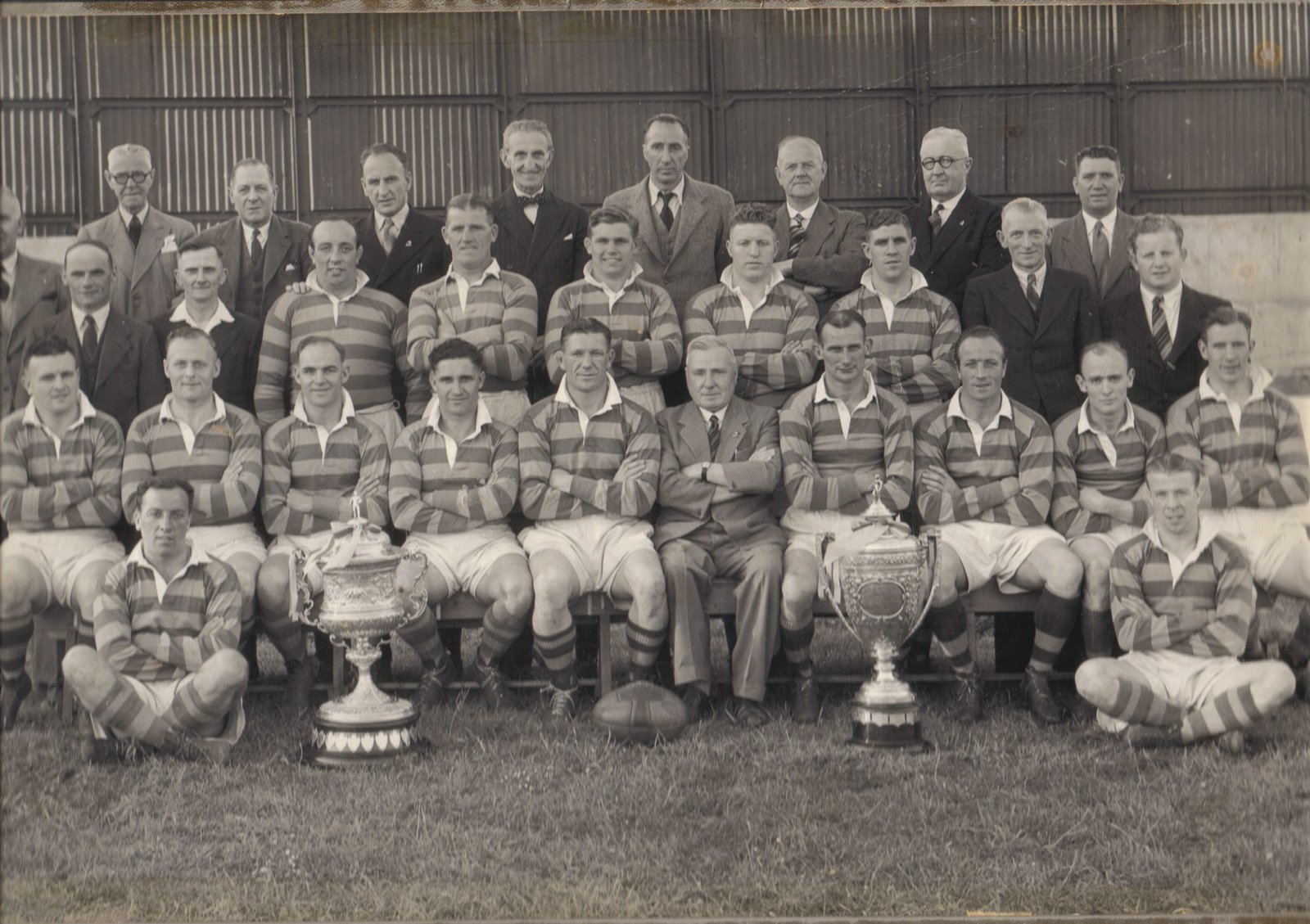
The 1948 squad with the Championship and Lancashire League trophies. Emlyn stands at the right-hand end of the first row of standing men. Reproduced by kind permission of the Warrington Wolves Heritage volunteers.
A second photograph puts him in the team group on a particular afternoon. On Saturday 21 February 1948 Warrington beat Halifax at home by 28 points to 6, with three tries from Ike Davies, two apiece from Brian Bevan and Bryn Knowelden, one each from Jack Featherstone and Gerry Helme, and two goals from Sammy Powell. In the back row, second from the left, between Fred Worrall the trainer and Albert Pimblett, stands E. Jenkins, coach.
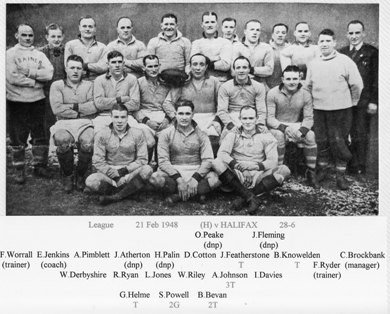
Warrington against Halifax, 21 February 1948, won 28-6. Emlyn is second from the left in the back row, captioned E. Jenkins (coach). Reproduced by kind permission of the Warrington Wolves Heritage volunteers.
The names around him in that photograph are worth pausing over. Brian Bevan, the Australian wing who would finish with more tries than any player in the history of the game, is sitting at the front. Gerry Helme, who would twice win the Lance Todd Trophy at Wembley, is beside him. Emlyn was thirty-seven, and coaching them.
He appears again a few pages later, among the portraits of the club's officials: the coach, alongside Chris Brockbank the secretary-manager, E. Foulkes the treasurer, and F. Ryder and F. Worrall the trainers. It is the only known photograph of him in the formal company of a club he worked for.
Source: Warrington RLFC commemorative book, season 1947-48, pages 8 and 30. Supplied and reproduced by kind permission of the volunteers of Warrington Wolves Heritage. Both pages are in the Archive.
The game plan
One photograph survives from the coaching years in which he is unmistakably doing the job. It was taken on 17 December 1949 by John Chillingworth for Picture Post, and it catches him mid-explanation, laying out his game plan to five of his players: Ledgard, Burke, Edden, Davies and Harris. Jimmy Ledgard was the full-back Leigh had signed for a record fee, who had played in the Lancashire Cup final that October. The man doing the talking had been the finest stand-off in Britain a dozen years earlier, and two months before this he had pulled a Leigh jersey on himself, at not quite thirty-nine, and scored. Here he is passing it on. Getty have titled it Tactics Talk.
The picture was not taken for the sports pages. It comes from a Picture Post photo-essay of 1949 called A Town Takes Its Team To Heart, about Leigh and what the club meant to it. In the year the magazine went looking for a town in love with its rugby team, the man they photographed at the blackboard was a collier's son from Treherbert.
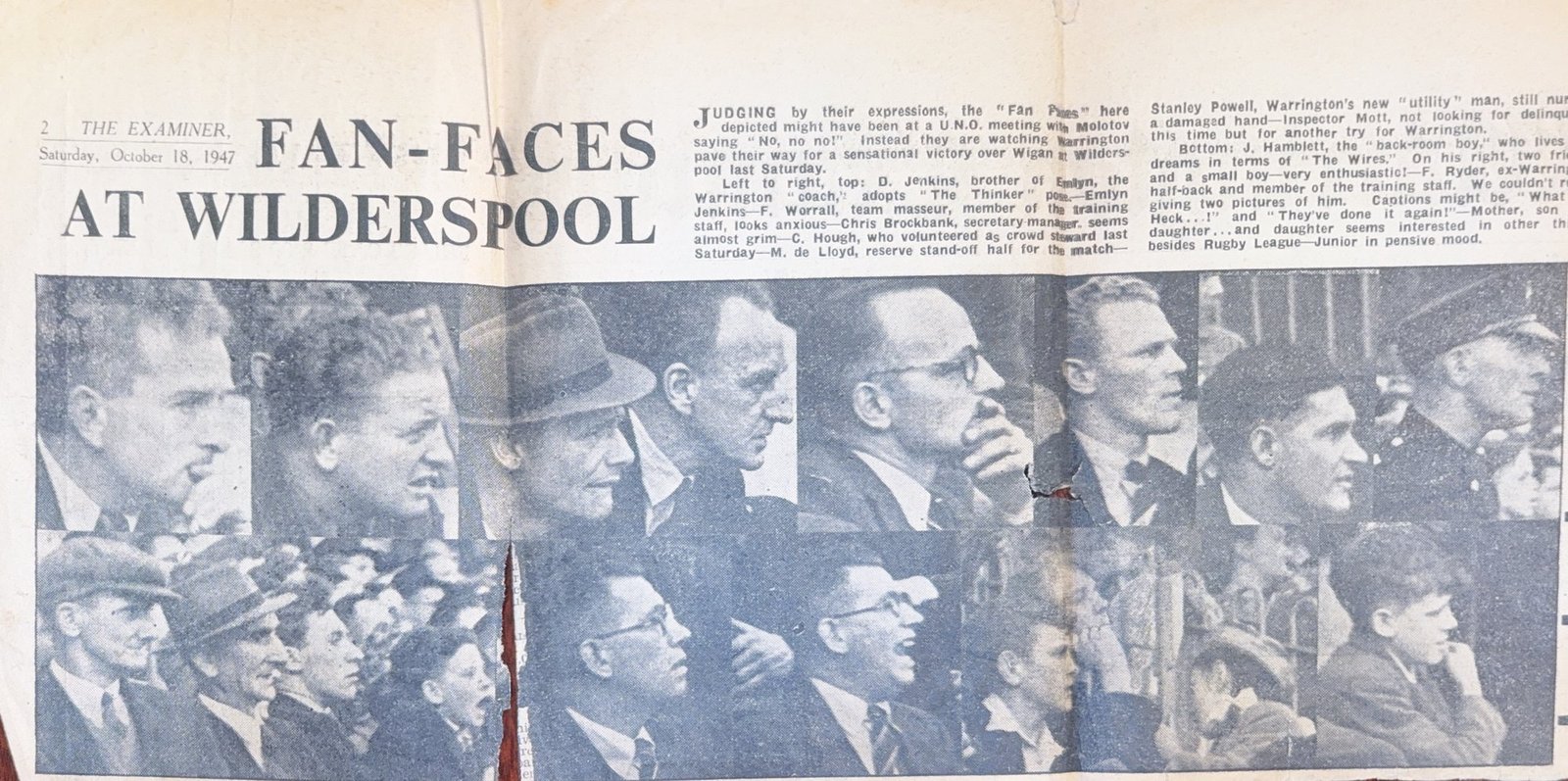
A local paper's lighthearted "fan-faces" feature from a Warrington win over Wigan in October 1947. Among the crowd captured watching: Emlyn, the Warrington coach, and beside him his brother Danny, identified in print for the only time found so far.
His teacher training at Risley, done almost as a sideline to the coaching, turned out to matter more than anyone could have guessed at the time. It was the qualification that let him go home.
A qualified man
It is easy to assume that a former international simply walked into coaching on his name. He did not. In July 1949, midway through his second Leigh spell, he was one of nearly forty club representatives at Headingley for the Rugby League's course for senior coaches, run to qualify candidates as regional coaches and form a central coaching pool that clubs could call upon. The list of those attending includes Emlyn Jenkins, Leigh, and, two names later, Gus Risman of Workington. The lecturers covered technique, physical research and nutrition. He was thirty-eight, seven years into the job, and going back to school for it.
Source: Yorkshire Evening Post, 18 July 1949, in the Archive.
St Helens, 1951
In January 1951 St Helens engaged him, and the Yorkshire papers carried it as a significant appointment: the Rugby League Test stand-off half of pre-war days, taken on by a club making a determined effort to reach the Championship play-off. One of them summarised his career in a single line that added a club nobody in the family knew about, calling him the former Salford, Wigan, Keighley and Bradford Northern international half back.
Three days later the Liverpool Echo answered local worries about what he was costing, and in doing so recorded the two most telling facts about his coaching career. St Helens had signed him as their player-coach, at forty years of age. And in his Leigh days, the paper says, Jenkins had been probably the highest paid coach in the game, though he had treated St Helens fairly and taken terms most satisfactory to the club.
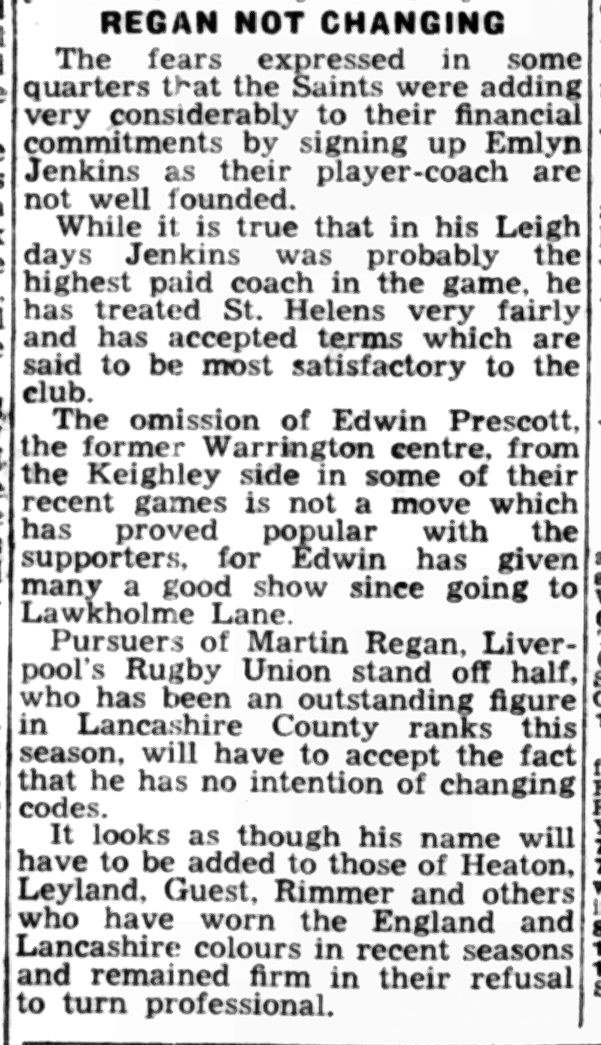
Liverpool Echo, 20 January 1951. The line about his Leigh salary is the only measure anyone has left of what he was worth as a coach.
It ended a year and a day after it began. On 16 January 1952 it was reported that by mutual consent St Helens and Emlyn Jenkins had agreed to bring his coaching engagement to a close. It was his last appointment at a club, and he was forty-one.
Sources: Bradford Observer and Yorkshire Post, both 17 January 1951; Liverpool Echo, 20 January 1951; Halifax Evening Courier, 16 January 1952. All in the Archive.
Health and Strength
Rugby was never the whole of it. At seventeen, still a haulage engine driver at 61 Miskin Street, Emlyn had taken out membership of the Health and Strength League, whose motto ran that the body was sacred even as the soul. That certificate, number 62555, is dated March 1928, two years before Cardiff and Salford and everything that followed. Twenty years later he was still with the League, and by then running it: in the summer of 1948 the Aberdare paper introduces him not as a rugby league international at all, but as the Health and Strength organiser for South Wales.
What he was doing that August was judging. Miners' holiday week at Aberdare Park, a large crowd, the Miss Aberdare and Junior Miss competitions, and Emlyn adjudicating alongside Dr Jack Wilson, with a vote of thanks moved to them both afterwards. He had the microphone as well as the clipboard, and he used it. He told the crowd he had asked a competitor at a parade the previous Monday evening why she called her swimming costume a MacArthur model, and reported that she had her answer ready.
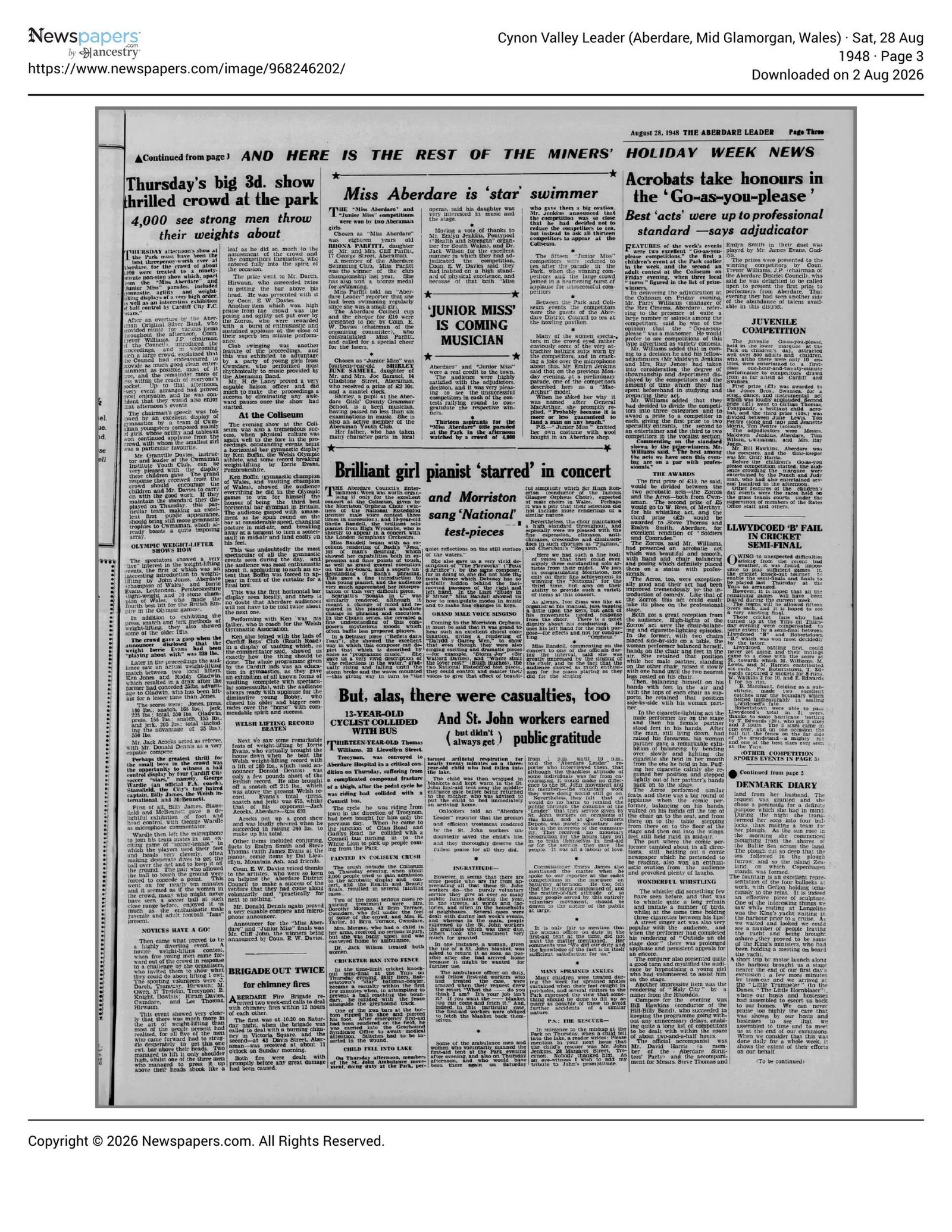
Aberdare Leader, 28 August 1948. Click to read the full page.
It is a small thing, and easy to pass over, but it fills in a shape the rugby record leaves out. The physical culture he took seriously as a boy in the Rhondda he was still organising for a whole region in middle age, and the man who could hold fifty thousand people at the Sydney Cricket Ground could also hold a park crowd in Aberdare with a joke about a swimming costume.
Sources: Health and Strength League membership certificate, 19 March 1928, and Cynon Valley Leader, 28 August 1948, both in the Archive. The 1948 report gives his address as Pontypool, in a summer when he was also coaching in Lancashire; how the two fitted together is not yet established.